

Power BI Copilot ROI: You've Invested. Now Make It Pay.
- madhupandit

- May 19
- 4 min read
Updated: May 25
Most organisations have switched Copilot on and are waiting for the magic. But Copilot isn't a button, it's a multiplier. And multiplying a broken data foundation gives you faster wrong answers.
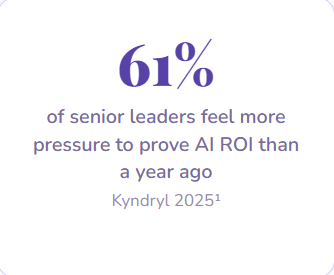
61% of senior business leaders are under more pressure to prove AI ROI than a year ago. Yet only 25% of AI initiatives deliver the returns that were expected.
Sound familiar? If you've recently invested in Microsoft Copilot for Power BI, that question is probably already coming from your board or finance director. The pressure to show a return on AI spend is real, growing, and according to IBM, most organisations are not meeting it.
The potential is not in question. IDC research shows AI delivering an average 3.7x return on every dollar invested, rising to $10.30 for organisations leading on AI readiness. The uncomfortable truth: most organisations are nowhere near that. Here is how to change it.
This blog is the next in the series:


01 — Reframe the Investment
What You Actually Paid For
Before we talk returns, it's worth clarifying what Copilot for Power BI actually is because most people think of it as a chatbot layered on top of their reports. That's an underestimate.
What you've actually invested in is an AI layer that sits across your entire data estate capable of generating reports from natural language prompts, summarising insights automatically, answering ad-hoc questions on live data, and now, with the May 2026 update, doing all of this on mobile, wherever your decision-makers are.
The shift this enables isn't incremental. It's a move from passive reporting — "here's what happened last month" — to active decision intelligence — "here's what you should do about it." Understanding that distinction is the foundation of measuring Power BI Copilot ROI correctly.


02 — The Return on Investment
Where Your Power BI Copilot ROI Actually Comes From
Let's be specific. There are four distinct areas where organisations see measurable returns from Copilot-enabled Power BI:


03 — The Hidden Drain on Your Power BI Copilot ROI
Why Most Organisations Aren't Seeing It Yet
The part nobody talks about in the sales pitch.
Copilot is only as intelligent as the data beneath it. If your semantic models are poorly structured, your fields carry cryptic names, your measures are inconsistent, or your pipelines are patching over messy source data, Copilot will confidently surface the wrong answers. Faster.
This is the hidden drain on your Power BI Copilot ROI. When only 1 in 4 AI initiatives delivers the expected return, the root cause is almost never the technology. It is the data foundation that was never ready to support it. The organisations in the top tier, those seeing $10.30 back for every dollar invested, almost all share one thing: they prepared before they deployed.
We covered this in detail in Part 1 of this series: preparing your data for AI isn't just good data hygiene. It's a prerequisite for getting any return on your Copilot investment.

04 — A Practical Diagnostic
Is Your Organisation Actually Seeing Power BI Copilot ROI?
You don't need a full audit to get an early read on your Power BI Copilot ROI. Ask your BI team these four questions:
Q1: Can Copilot answer questions about our data correctly?
If your team hesitates, or has examples of Copilot returning plausible-but-wrong answers, your semantic model likely needs attention before AI can be trusted at scale.
Q2: Are non-technical users actually using Copilot independently?
If only the BI team uses Copilot and business users still raise requests, then the self-service ROI lever isn't being pulled. This points to either a training gap or a data trust problem.
Q3: How long does it take to go from a business question to a reliable answer?
If the answer is still "a few days," Copilot isn't yet in the loop for real decisions. You're paying for a capability your workflows haven't adopted.
Q4: Do we have a single, trusted version of our key metrics?
Copilot can only return one answer. If your organisation debates which revenue figure is "correct," AI will amplify that confusion, not resolve it.
05 — The Mindset Shift
From Licence Fee to Competitive Advantage
The organisations already seeing strong Power BI Copilot ROI share one thing in common: they treated data readiness as a pre-condition of the AI investment, not an afterthought. They cleaned their models, standardised their metrics, and built semantic layers that Copilot could reason over confidently. They are in the 25% that delivers. The other 75% are still waiting for the magic.
The result for those who prepared? Decisions that used to take days take minutes. Analysts who used to build reports now generate strategy. Leaders who used to wait for the monthly pack now query live data from their phones.
That's not a product demo scenario. It's already happening in well-prepared organisations. The question is whether yours is one of them.
Copilot rewards preparation. AI delivers 3.7x returns on average, and $10.30 for every dollar for those who built the right foundation first.
Not Sure If Your Data Is Copilot-Ready?
Book a free Discovery Call with us. In 30 minutes, we'll give you an honest assessment of where you stand, and what it would take to start seeing real returns.
The AI-Ready Data Series
Part 1 — How to Prepare Your Data for AI
Part 2 — You've Invested in Copilot. Now Make It Pay. ← You are here
Part 3 — Coming Soon: Why Most Teams Use Less Than 30% of Power BI's AI Potential
Sources: ¹ Kyndryl 2025 Readiness Report: cio.com/article/4114010
² IDC 2024 Business Opportunity of AI, commissioned by Microsoft: news.microsoft.com
³ IBM CEO Study: ibm.com/think/insights/ai-roi
Comments